

🇸🇩 Travel Guide to Sudan — The Land of the Black Pharaohs
This comprehensive travel guide to Sudan will help you discover a country of ancient pyramids, vast deserts, and the legendary Nile. From the royal necropolises of Meroë to the bustling markets of Khartoum and the coral reefs of the Red Sea, this travel guide to Sudan covers everything you need to know about this fascinating nation. As the home of the ancient Kingdom of Kush, Sudan boasts more pyramids than Egypt, along with a rich tapestry of Nubian, Islamic, and colonial heritage. Whether you're exploring the temple ruins of Naqa, diving in the Red Sea's pristine waters, or experiencing the warmth of Sudanese hospitality, this travel guide to Sudan is your essential companion.
⚠️ Critical Travel Advisory — Level 4: Do Not Travel: The U.S. Department of State, UK FCDO, Australian DFAT, and multiple other governments advise against all travel to Sudan due to armed conflict, civil unrest, crime, kidnapping, terrorism, landmines, and health threats. The security situation is volatile and can deteriorate rapidly with little warning. Khartoum has seen heavy fighting, and Port Sudan is currently the functioning capital. The U.S. embassy in Khartoum suspended operations in 2023, and consular services are extremely limited. This travel guide to Sudan is intended for informational and cultural reference purposes only. Do not travel to Sudan under any circumstances.[reference:0][reference:1]
📢 AdSense Leaderboard #1 (728x90 or responsive)
📊 Quick Facts
- Capital: Khartoum 💡 The capital where the Blue and White Niles meet — Port Sudan is currently the functioning capital
- Currency: Sudanese Pound (SDG) 💡 1 USD ≈ 4,500–6,000 SDG (check parallel market rates)[reference:2]
- Language: Arabic, English 💡 Arabic is the official language; English is widely understood[reference:3]
- Population: ~50 million (2026 est.)[reference:4]
- Area: 1,886,068 km²
- Time Zone: UTC +2 (CAT)
📅 Plan Your Perfect Trip with This Travel Guide to Sudan
When planning your travel guide to Sudan, the desert climate brings extreme temperatures. The best time to consider a visit to Sudan — if conditions were safe — would be during the cooler months from October to March, when daytime temperatures average around 30°C and nights are much cooler[reference:5][reference:6]. The ideal window is December to February, with average daytime highs of 30°C and comfortable nights[reference:7]. Summer (April–September) is dangerously hot, with temperatures regularly exceeding 45°C in the northern desert regions[reference:8]. The main rainy season is from April to October, with rainfall concentrated in the south[reference:9]. This travel guide to Sudan is for informational reference only — do not travel.
Best for: Theoretical exploration of Nubian pyramids and Red Sea coast — comfortable desert temperatures[reference:10]
Extreme heat — regular temperatures above 45°C in the north; dangerous for outdoor activity[reference:11]
Rainfall concentrated in the south — can fall during any month[reference:12]
The practical window for exploring Meroë, Naqa, and Jebel Barkal[reference:13]
📢 AdSense Leaderboard #2 (728x90 or responsive)
🛂 Visa Information for Your Travel Guide to Sudan
Visa Requirements: Most nationalities require a visa to enter Sudan. An e‑visa is available for many nationalities[reference:14]. American and Indian passport holders can obtain an e‑visa with processing typically taking around 10 days[reference:15]. British and Emirati passport holders require a sticker visa[reference:16]. UAE citizens may obtain a visa on arrival[reference:17]. For a complete travel guide to Sudan, verify your requirements with the nearest Sudanese embassy before any travel planning.
📋 Visa Requirements
- Passport Validity Must be valid for at least six months beyond your intended stay with at least two blank pages[reference:18][reference:19]
- E‑Visa Available for many nationalities — apply online before travel[reference:20]
- Student Visa For academic study — requires enrolment at a recognised Sudanese institution
- Work Visa For employment — requires a job offer and work permit approval
🔗 Official Resource: Ministry of Foreign Affairs of Sudan (Check local embassy for latest visa details)
📚 Trusted Resources for Your Travel Guide to Sudan
- UNESCO World Heritage Sites Includes Meroë, Jebel Barkal, and the ancient Nubian sites[reference:21]
- U.S. Department of State – Sudan Official Level 4: Do Not Travel advisory[reference:22]
- UK FCDO – Sudan Advises against all travel to Sudan
🌍 Explore our other guides: Egypt · South Sudan · Ethiopia
💡 Key Travel Tips for Your Sudan Exploration (Information Only)
The Sudanese Pound (SDG) is official — carry USD cash. The parallel market rate is significantly higher than the official rate[reference:23]
Try kissra (flatbread), aseeda (porridge), kajaik (dried fish stew), and fresh Nile fish[reference:24][reference:25]
Sudan is a predominantly Muslim country — dress modestly, respect religious sites and traditions
Medical facilities are extremely limited. Cholera, dengue fever, and malaria are prevalent[reference:26]. Drink only bottled water
ALL travel is strongly discouraged. Armed conflict continues across the country[reference:27]. The airport has been subject to drone attacks[reference:28]
Mobile network coverage is limited to major cities; internet can be unreliable
🏙️ Top Cities and Destinations in Sudan
The capital at the meeting of the Blue and White Niles — National Museum of Sudan, Omdurman Market, and Al-Fateh Tower[reference:29]
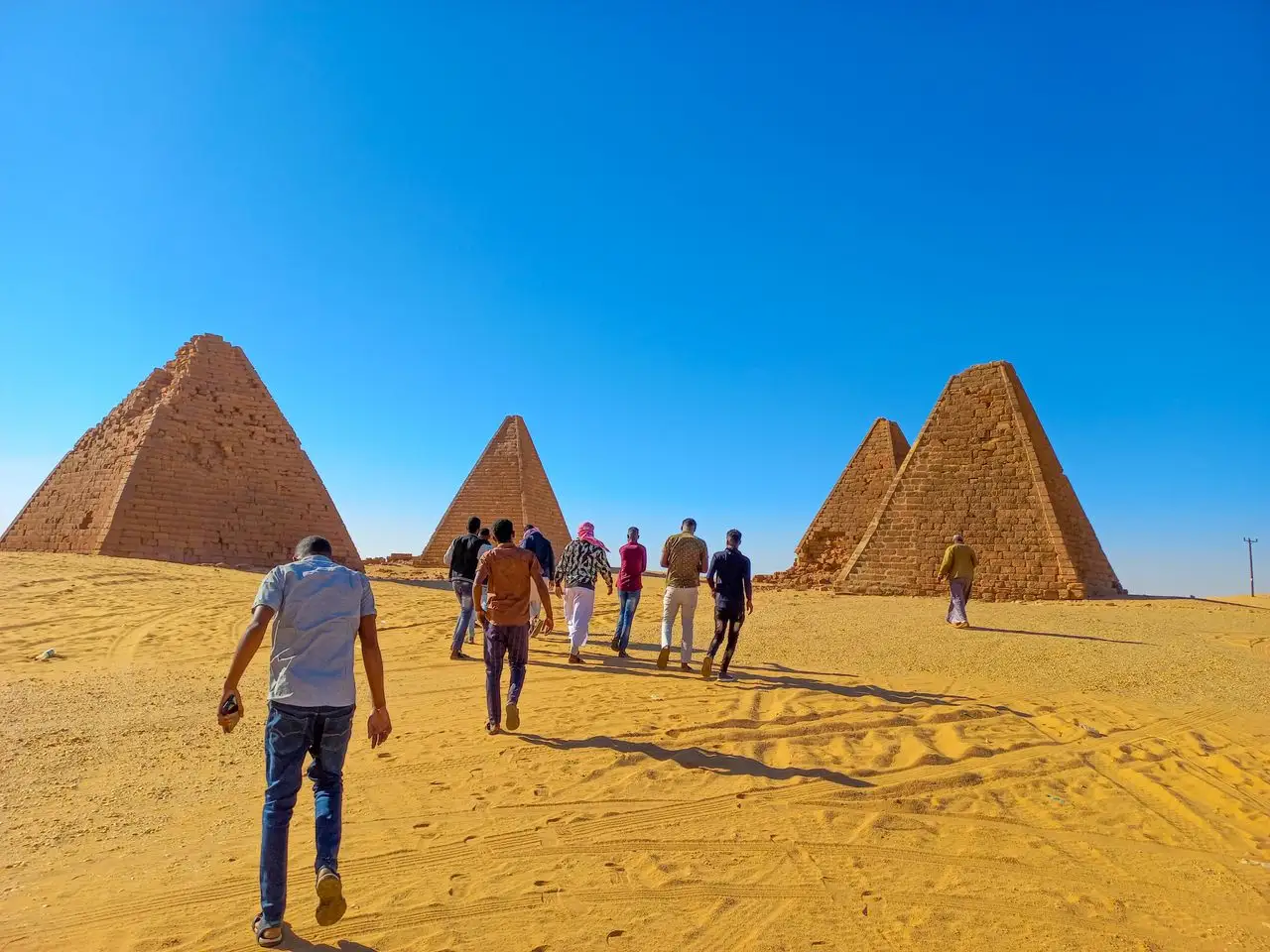
💡 Best time: (theoretical) Nov–MarThe royal necropolis of Kush — over 200 pyramids in the Nubian desert, a UNESCO World Heritage site[reference:30]
💡 Best time: (theoretical) Oct–AprThe temple fields of the Kingdom of Kush — unique sandstone temples and ancient ruins[reference:31]
💡 Best time: (theoretical) Oct–AprThe sacred sandstone outcrop — a UNESCO World Heritage site with ancient temples[reference:32]
💡 Best time: (theoretical) Oct–AprThe Red Sea port — gateway to the coral reefs, diving, and the historic ruins of Suakin[reference:33]
💡 Best time: (theoretical) Oct–AprThe ancient Red Sea port — Ottoman and coral‑stone architecture, undergoing restoration[reference:34]
💡 Best time: (theoretical) Oct–AprOne of Sudan's oldest national parks — Guinea fowl, warthogs, and Olive Baboons[reference:35]
💡 Best time: (theoretical) Nov–MarMedieval Christian Nubian capital — mud‑brick monuments and black‑topped pottery[reference:36]
💡 Best time: (theoretical) Oct–Apr📢 AdSense Leaderboard #3 (728x90 or responsive)
🏨 Top Hotels in Sudan
Accommodation in Sudan is limited, with most hotels concentrated in Khartoum and Port Sudan. Many hotels have been affected by the ongoing conflict[reference:37]. Always verify availability through official channels.
Khartoum
Contact directly 🏨 New luxury hotel on Nile Street — the iconic "Gaddafi Egg"[reference:38]Khartoum
Contact directly 🏨 Well‑known hotel on Nile Street — panoramic city views[reference:39]Port Sudan
Contact directly 🏨 Limited accommodation in the current functioning capital[reference:43]⚠️ Please note: Hotel availability and contact details are subject to change. All travel to Sudan is strongly discouraged. Verify through official channels if absolutely necessary.
🎓 Top Universities in Sudan
Sudan has a well‑established higher education system with numerous public and private universities.
Khartoum
Visit Website → 🏆 The oldest public university in Sudan — ranked #1[reference:44][reference:45]Khartoum
Visit Website → 📚 Ranked #2 — leading in science and technology[reference:46]Omdurman
Visit Website → 📚 One of Sudan's leading Islamic universities[reference:48]Wad Madani
Visit Website → 📚 A major public university outside Khartoum[reference:49]Omdurman
Visit Website → 📚 A leading private university for women[reference:50]⚠️ Please note: University operations and website availability may be affected by the security situation in Sudan. Always verify through official channels.
🌺 Culture & Cuisine in Sudan
Sudanese culture is a rich fusion of African and Arab influences, shaped by the ancient Kingdom of Kush, centuries of Islamic civilisation, and its position as a crossroads of the Nile. The country is home to over 500 ethnic groups and 75 languages[reference:51][reference:52]. The official languages are Arabic and English[reference:53]. Sudan is predominantly Muslim, with Islamic traditions deeply woven into daily life. The country celebrates a range of festivals, including Eid al‑Fitr, Eid al‑Adha, and the Nubian festivals that honour the region's ancient heritage. Traditional music and dance, such as the tambour and dallooka, are an integral part of Sudanese culture, along with the poetry and storytelling traditions of the Nubian people.
Sudanese cuisine is built around the staple kissra, a flatbread made from sorghum, wheat, or corn flour, which is eaten with stews[reference:54][reference:55]. The national dish is a stew served with kissra, featuring ingredients such as dried fish (kajaik), meat, or vegetables[reference:56]. Other staples include aseeda (a thick sorghum porridge), gurassa (a thick corn bread), and nasha (a thin fermented sorghum porridge)[reference:57][reference:58][reference:59]. Fresh Nile fish is abundant, and grilled meats are popular. Meals are often accompanied by shai (sweet tea) or karkadeh (hibiscus tea). The cuisine reflects the diverse influences of West African, Arabic, and European cookery[reference:60].
Dress codes are modest in Sudan, especially for women, who should cover their shoulders and knees in public. Friday is the Muslim day of rest, and many businesses close for prayers. The Sudanese are known for their warmth and hospitality — guests are often welcomed with tea and generous meals.
🇸🇩 Explore the history and culture of Sudan — from a safe distance.
Learn about Sudan's ancient pyramids, diverse cultures, and rich traditions.
Read Our Full Travel Guide →This travel guide to Sudan is your ultimate cultural and historical resource. Understand this ancient land's remarkable heritage through our expert insights — but do not travel to Sudan under current conditions.