
Planning a festive city break and torn between Vienna vs Budapest? Both are Danube capitals of the old Habsburg Empire, both have some of Europe's best Christmas markets, and they are only about 2 hours 40 minutes apart by train. But they offer very different trips: Vienna is grand, musical and polished; Budapest is cheaper, livelier and famous for steaming outdoor thermal baths. Written from Prague, a short train ride from both, this guide compares markets, food, culture, prices and getting around.
- Choose Vienna for classical music, palaces, elegant coffee houses and the most traditional Christmas markets.
- Choose Budapest for lower prices, outdoor thermal baths in the snow, lively nightlife and big Danube views.
- Markets: both usually open in mid-November. Vienna's main markets close around 24–26 December; Budapest's run to around New Year.
- Can't choose? Do both: direct trains link them in about 2 hours 40 minutes.

Vienna vs Budapest at a glance
 Vienna |  Budapest | |
|---|---|---|
| Feel | Imperial, elegant, orderly | Grand but gritty, lively, romantic |
| Christmas markets | Rathausplatz, Schönbrunn, Spittelberg, Belvedere | Vörösmarty Square, St Stephen's Basilica |
| Market season | Usually mid-Nov to 24–26 Dec | Usually mid-Nov to around 1 Jan |
| Warm-up | Coffee houses and cake | Outdoor thermal baths |
| Culture | Opera, concerts, palaces, museums | Parliament, castle hill, ruin bars, baths |
| Currency | Euro (EUR) | Forint (HUF) |
| Cost | Higher | Lower (often 30–40% cheaper) |
| Getting there | Vienna International Airport, trains | Budapest Airport, trains |
Both cities are very safe and walkable, with excellent trams and metros. Compare Austria and Hungary on our Compare Countries page.
Vienna vs Budapest Christmas markets: which is better?
 Vienna's Christmas markets
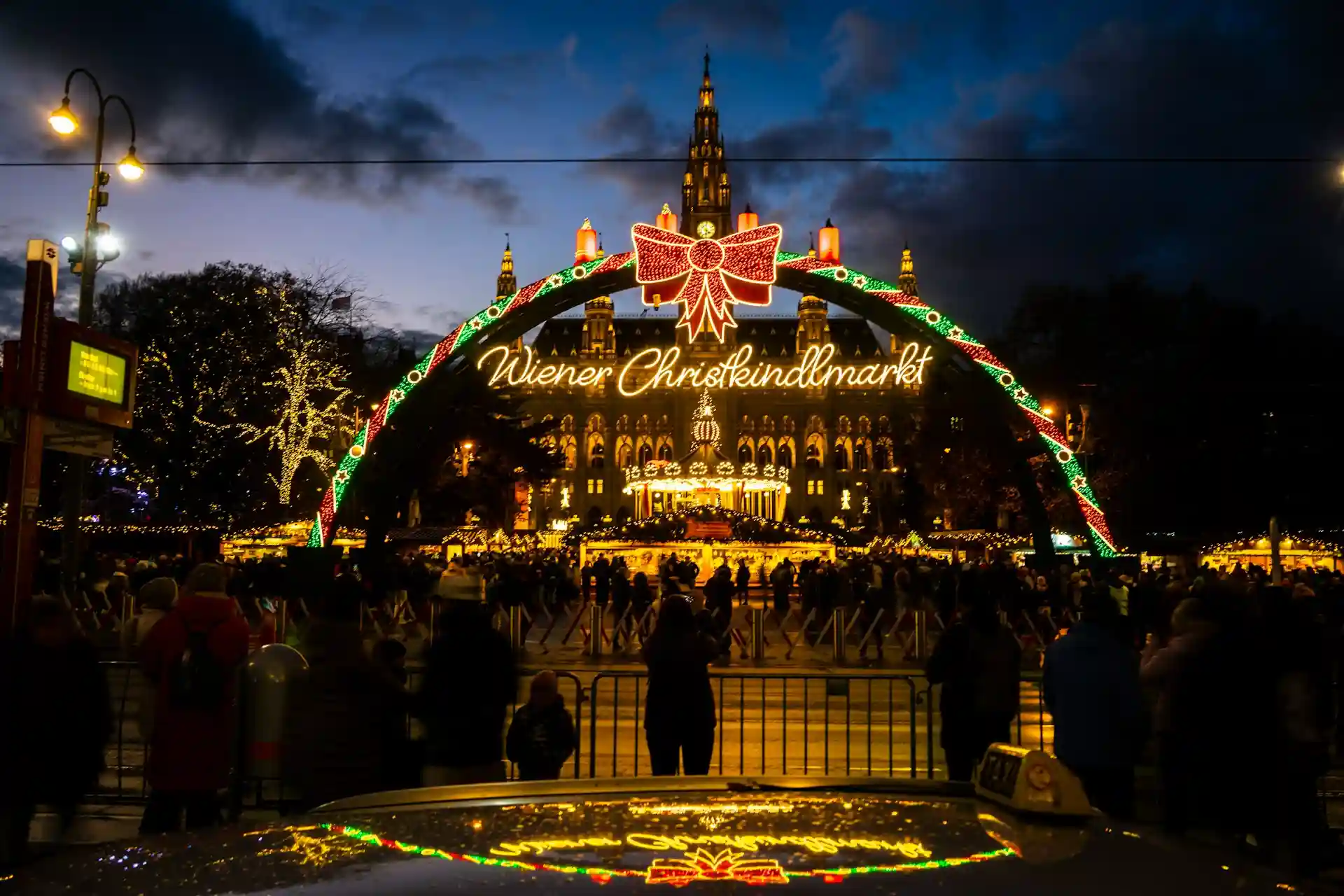
Vienna is often called the capital of Christmas markets, with around 20 across the city. The Wiener Christkindlmarkt at Rathausplatz in front of the neo-Gothic City Hall is the biggest, with a giant tree, lit-up park trees and an ice rink. The Schönbrunn Palace market has an imperial backdrop and quality crafts, while Spittelberg is cosy, with cobbled lanes and artisan stalls. Most markets open in mid-November and close around 24–26 December; some reopen as New Year markets.
Budapest's Christmas markets
Budapest has fewer but very popular markets. The Vörösmarty Square market is the classic, with food stalls and live music, and the St Stephen's Basilica market adds an ice rink around the tree and a nightly light show projected on the basilica facade. Markets usually run from mid-November until around New Year, so they are still open between Christmas and 1 January, when Vienna's main markets have closed.
Verdict: Vienna for variety and tradition; Budapest for atmosphere, light shows and a longer season.
Vienna vs Budapest food and drink at the markets
| Try this | Vienna | Budapest |
|---|---|---|
| Hot drink | Punsch (fruit punch, often with rum) and Glühwein | Forralt bor (mulled wine) |
| Snack | Roasted chestnuts (Maroni), Bratwurst | Lángos (fried bread with sour cream and cheese) |
| Sweet | Kaiserschmarrn and Vanillekipferl biscuits | Kürtőskalács (chimney cake) and bejgli (poppy-seed or walnut roll) |
| Hearty dish | Käsekrainer sausage | Töltött káposzta (stuffed cabbage) and goulash |
Tip: in Vienna, hot drinks come in a souvenir mug with a deposit of a few euros; return it for your money or keep it as a souvenir.
Vienna vs Budapest culture: opera or thermal baths?
Vienna is unbeatable for classical culture. Even on a budget you can see the Vienna State Opera with standing-room tickets that cost only a few euros, and churches and palaces host Advent concerts. Add Schönbrunn and the Hofburg, Klimt's The Kiss at the Belvedere, and an afternoon in a historic coffee house, a tradition UNESCO lists as intangible heritage.
Budapest has its own grand side, including the beautifully restored Hungarian State Opera, but its winter highlight is soaking in a thermal bath. At Széchenyi, outdoor pools of around 38°C steam in the frosty air while locals play chess. Add the Parliament, Buda Castle, Fisherman's Bastion and an evening Danube cruise past the lights.
Verdict: Vienna for music lovers; Budapest for a relaxing, unforgettable spa experience.
Vienna vs Budapest cost: which is cheaper?
Budapest is clearly cheaper. Hotels, meals, drinks and transport typically cost about a third less than in Vienna, and a luxury palace hotel in Budapest can cost the same as a mid-range hotel in Vienna.
| Daily budget per person (approx., 2026) | Vienna | Budapest |
|---|---|---|
| Budget | US$80–130 | US$50–85 |
| Mid-range | US$170–280 | US$110–190 |
| Luxury | US$450 + | US$350 + |
Hotel prices rise sharply on December weekends in both cities, so book early. In Budapest, always pay in forints and decline card-machine conversions; check our currency converter for today's rates.
How to visit both on one trip
Vienna and Budapest make a perfect pair. Direct Railjet trains link the two in about 2 hours 40 minutes, several times a day, and they arrive in the city centres. A classic 5–6 day trip:
- Days 1–3, Vienna: Rathausplatz and Spittelberg markets, Schönbrunn, the Opera.
- Day 4: morning train to Budapest; evening at the Basilica light show.
- Days 5–6, Budapest: Széchenyi Baths, Buda Castle, Vörösmarty market and a Danube cruise.
Coming from Prague? Trains reach Vienna in about 4 hours, so you can add Czechia for a three-capital Christmas trip.
Practical tips for Christmas in Vienna and Budapest
Many shops, museums and some markets close or shorten hours; plan meals ahead.
Expect 0–5°C, sometimes below freezing.
Both are in the Schengen Area; see our ETIAS 2026 guide for upcoming changes.
Use the Wiener Linien app in Vienna and BudapestGO in Budapest.
Vienna has its Silvesterpfad street party; Budapest has fireworks over the Danube.
Bring flip-flops and a swimsuit; book Széchenyi tickets online.
Vienna vs Budapest: our verdict
Pick Vienna if…- You love classical music and palaces
- You want the most traditional markets
- Coffee houses and cake are your idea of bliss
Pick Budapest if…- You want more for your money
- Outdoor thermal baths sound perfect
- You are travelling between Christmas and New Year
Read our full guides: travel guide to Austria and travel guide to Hungary.
❓ Frequently asked questions
Is Vienna or Budapest better for Christmas markets?
Vienna has more markets and the most traditional atmosphere; Budapest has fewer markets but a longer season, light shows and lower prices.
When do the Vienna and Budapest Christmas markets open?
Both usually open in mid-November. Vienna’s main markets close around 24–26 December, while Budapest’s usually run until around New Year.
Is Budapest cheaper than Vienna?
Yes. Budapest is typically about a third cheaper than Vienna for hotels, food and drinks.
Vienna vs Budapest: how far apart are they?
About 240 km by road. Direct trains take about 2 hours 40 minutes.
Can you do Vienna and Budapest in one trip?
Yes. Spend three days in each, linked by a direct train. Five or six days in total works well.
Are the Budapest thermal baths open in winter?
Yes. Baths such as Széchenyi are open all year, and soaking outdoors in winter is a highlight.
What currency do I need for Vienna and Budapest?
Euros in Vienna and Hungarian forints in Budapest. Cards are widely accepted in both.
🎄 Plan your Christmas city break
Explore our Europe guides, or compare Austria and Hungary side by side.
Sources:
✈️ Planning this trip?
Compare hotel prices for your dates on Booking.com. Many rooms have free cancellation, so you can lock in a good price now.
📖 Keep reading

Seychelles vs Mauritius: Which Indian Ocean Island Should You Choose?
Seychelles vs Mauritius compared: beaches, cost, flights, things to do, food, and the best time to visit, so you can pick the right island…

12 Best Places to Visit in 2027: Travel Destinations Worth Planning For
Discover 10 of the best places to visit in 2027, from Norway's spectacular fjords and Egypt's ancient wonders to Jaipur's literary festival, Chile's southern…

20 Most Endangered Animals in the World (2026 List)
Meet the 20 most endangered animals in the world in 2026, from the vaquita to the Amur leopard: where they live, how many are…